When Your Inner Critic Became Your Protector

Most people know what it feels like to have an inner critic.
It is the voice that tells you that you should have done better. That you are behind. That you are too much, not enough, too sensitive, too needy, too lazy, too emotional, too difficult, or too flawed.
It may show up after a conversation, replaying everything you said and convincing you that you sounded awkward. It may appear when you are trying something new, warning you that you are going to fail. It may become louder when you rest, telling you that you should be doing more. It may criticize your body, your relationships, your emotions, your choices, or your pace.
For many people, the inner critic feels harsh and exhausting. It can contribute to anxiety, perfectionism, overthinking, low self-worth, and a constant sense of never feeling good enough.
So naturally, you may want to get rid of it.
But what if your inner critic is not just a cruel voice inside you?
What if it is a protective part of you that learned criticism was the best way to keep you safe?
This does not mean the critic is always helpful. It does not mean the things it says are true. But it may mean that this part of you developed for a reason. And when we understand the inner critic through a more compassionate, IFS-informed lens, we can begin to relate to it differently.
Instead of asking, “How do I silence my inner critic?” we might begin by asking, “What is this part of me trying to protect me from?”

What the Inner Critic Can Sound Like
The inner critic does not always sound the same for everyone.
For some people, it is loud and obvious. It may say things like:
“You are going to mess this up.”
“No one really likes you.”
“You should be further ahead by now.”
“You are too sensitive.”
“You always ruin things.”
“You need to be perfect or people will leave.”
For others, the inner critic is more subtle. It may show up as constant second-guessing, chronic guilt, fear of disappointing others, difficulty resting, or the feeling that you have to earn love by being useful, agreeable, successful, or easy to be around.
Sometimes the inner critic hides behind productivity. It convinces you that you are only valuable when you are achieving.
Sometimes it hides behind people-pleasing. It tells you that having needs will make you a burden.
Sometimes it hides behind perfectionism. It says that if you never make mistakes, no one can judge, reject, or shame you.
Sometimes it hides behind overthinking. It tries to analyze every possible outcome so you can avoid being hurt.
On the surface, this voice may seem like it is working against you. But underneath, it may believe it is helping you survive.
Why Self-Criticism Can Become a Protective Strategy
Self-criticism often develops in environments where being imperfect, emotional, visible, or needy did not feel safe.
If you were criticized often, you may have learned to criticize yourself first. That way, no one else could surprise you with it.
If you were expected to be responsible, mature, or high-achieving, you may have learned to push yourself constantly so you would not disappoint others.
If love felt conditional, you may have learned to monitor yourself closely so you could stay accepted.
If you were shamed for having emotions, you may have learned to judge your feelings before anyone else could.
If your needs were dismissed, you may have learned to tell yourself that your needs were “too much.”
This is how the inner critic can become a protector.
It may have learned: “If I keep you small, you will not be rejected.”
“If I keep you perfect, you will not be criticized.”
“If I keep you productive, you will not be seen as lazy.”
“If I keep you alert, you will not be blindsided.”
“If I keep you pleasing others, you will not be abandoned.”
The critic may be harsh, but its deeper fear is often pain, shame, rejection, failure, abandonment, disappointment, and/or loss of control.
In this way, the inner critic is not necessarily trying to destroy you. It may be trying to prevent you from experiencing something that once felt unbearable.

An IFS-Informed Way to Understand the Inner Critic
Internal Family Systems (IFS), is a therapeutic approach that understands the mind as having different “parts.” From this perspective, we all have parts of us that carry different emotions, fears, roles, and protective strategies.
You might have a part that wants connection, and another part that fears being vulnerable.
You might have a part that wants to rest, and another part that feels guilty when you slow down.
You might have a part that longs to be seen, and another part that worries visibility will lead to judgment.
An IFS-informed lens does not see these parts as bad. Instead, it invites curiosity. Each part is understood as having a role, even if that role is no longer serving you.
Your inner critic may be one of these parts.
It may believe that if it keeps you working harder, you will be safe.
It may believe that if it points out every flaw, you can fix yourself before anyone else notices.
It may believe that if it keeps you prepared for rejection, rejection will hurt less.
It may believe that if it shames you into changing, you will finally become acceptable.
Of course, being criticized from within rarely creates true safety. Over time, it often creates anxiety, self-doubt, emotional exhaustion, and disconnection from yourself.
But when you understand the critic as a protective part, you no longer have to meet it with more shame. You can begin to meet it with curiosity.
Why Fighting the Inner Critic Often Makes It Louder
When the inner critic is painful, it makes sense to want to push it away.
You may tell yourself: “Stop thinking like this.”
“Why am I so negative?”
“I hate this part of me.”
“I should be more confident by now.”
But often, this creates another layer of inner conflict. Now there is the original critical voice, and then another part of you criticizing yourself for having an inner critic.
This can make the critic louder.
From an IFS-informed perspective, protective parts tend to intensify when they feel ignored, attacked, or dismissed. If your inner critic believes it is protecting you from danger, it may not relax simply because you “tell it to go away”. In fact, it may become more urgent.
The goal is not to let the critic take over. The goal is to build enough space inside yourself to notice it without becoming it.
There is a difference between saying, “I am a failure,” and saying, “A part of me is afraid I am failing.”
There is a difference between saying, “I am too much,” and saying, “A part of me learned that having needs might push people away.”
There is a difference between saying, “I can never mess up,” and saying, “A part of me believes mistakes are unsafe.”
That small shift matters more than you think…
It helps you remember that you are not the critical voice. You are the person becoming aware of it.
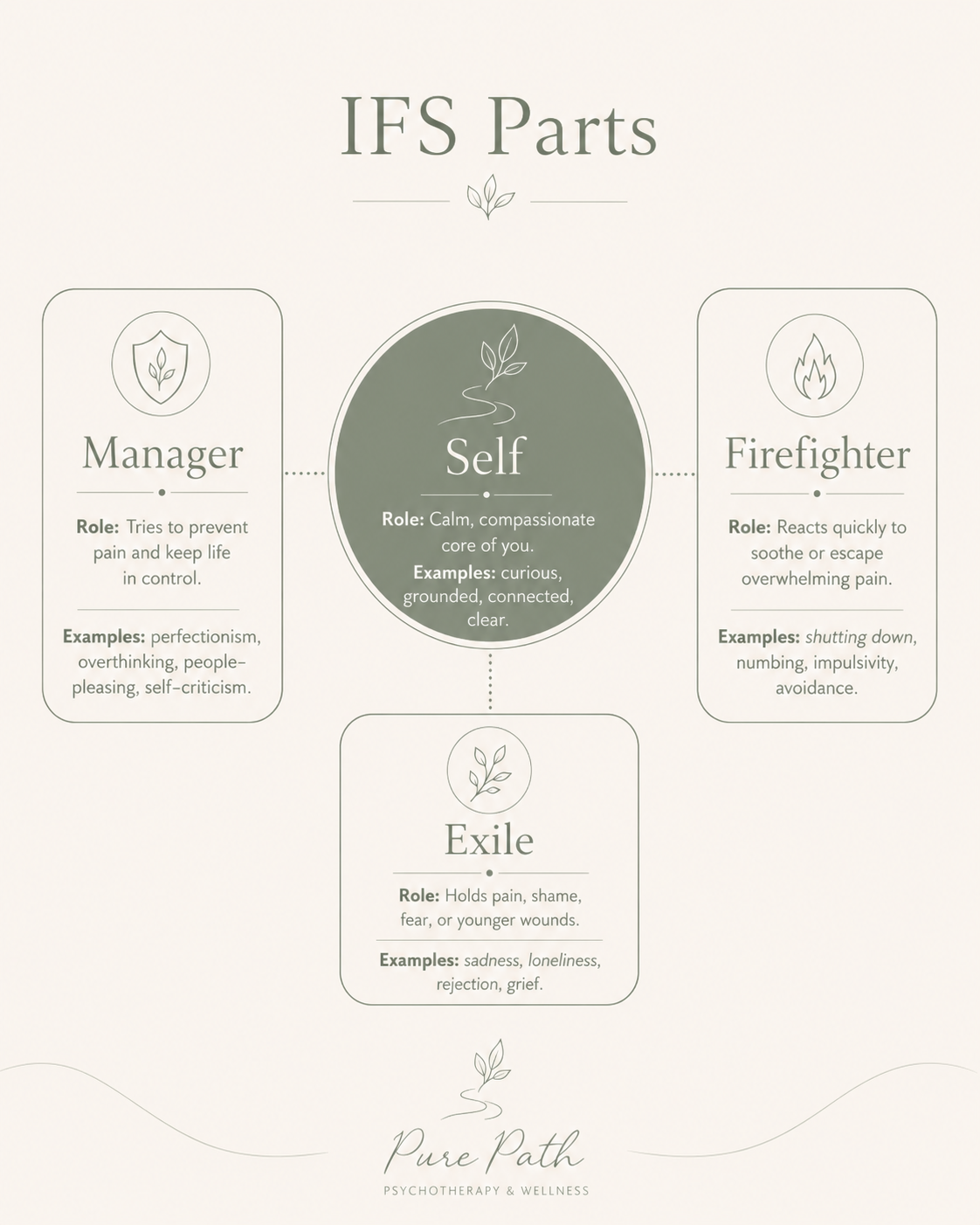
What Your Inner Critic May Be Protecting
If you struggle with self-criticism, anxiety, perfectionism, or people-pleasing, your inner critic may be protecting you from deeper fears.
It may be protecting you from shame. This can happen if you learned that mistakes made you unworthy, embarrassing, or unacceptable. The critic tries to prevent shame by pushing you to be flawless.
It may be protecting you from rejection. If acceptance once depended on being easy, impressive, agreeable, or useful, the critic may pressure you to become whatever others want you to be.
It may be protecting you from failure. If failure felt dangerous, humiliating, or deeply disappointing, the critic may try to keep you from taking risks at all.
It may be protecting you from abandonment. If connection felt uncertain, the critic may tell you to hide your needs, silence your feelings, or avoid conflict so people will stay.
It may be protecting you from vulnerability. If being open once led to hurt, the critic may keep you guarded by convincing you that your emotions are too messy or unsafe to share.
Again, this does not mean the critic is right. It means the critic may be scared. And scared parts often need compassion before they can soften.
Meeting the Inner Critic With Curiosity
Healing your relationship with your inner critic does not happen by pretending the voice is not there. It happens by learning how to respond to it differently.
The next time your inner critic becomes loud, you might gently pause and ask:
“What is this part of me afraid would happen if it stopped criticizing me?”
“What is it trying to prevent?”
“When did I first learn that I had to speak to myself this way?”
“What does this part believe it needs from me?”
“What would it be like to respond with firmness and compassion instead of shame?”
You do not have to force an answer. The point is not to analyze yourself perfectly. The point is to become curious enough to interrupt the automatic cycle of self-attack.
Sometimes, you might notice that your critic is trying to motivate you. Sometimes, it is trying to protect you from embarrassment. Sometimes, it is trying to stop you from wanting something that feels risky. Sometimes, it is trying to keep you from feeling an older wound.
You can acknowledge the intention without agreeing with the method. You might say to this part:
“I understand that you are trying to protect me, but I do not need to be attacked in order to grow.”
“I hear that you are scared, but shame is not the only way to keep me safe.”
“Thank you for trying to help me survive. I am learning a different way now.”
This kind of response may feel strange at first, especially if you are used to speaking to yourself harshly. But over time, it can help create more inner safety.

You Are More Than the Critical Voice
One of the most important things to remember is that your inner critic is only one part of you.
It may be loud, but it is not all of you.
There may also be a part of you that longs for rest. A part of you that wants to feel confident. A part of you that wants to be loved without performing. A part of you that is tired of trying to be perfect. A part of you that wants to create, speak, choose, feel, receive, and live more freely.
When the inner critic has been leading for a long time, these softer parts may feel harder to access. But they are still there.
Therapy can help you begin to notice the different parts of yourself with more compassion. It can help you understand where self-criticism began, what it has been trying to protect, and how to build a kinder relationship with yourself.
This does not mean you will never have critical thoughts again. Healing is not about never being triggered, never doubting yourself, or never hearing that old voice.
It is about having more choice in how you respond. It is about recognizing when the critic is present without handing it the microphone. It is about learning that growth does not require self-punishment. It is about discovering that you can be accountable without being cruel to yourself.
You can make mistakes and still be worthy. You can be imperfect and still be loved. You can have needs and still belong. You can grow without shaming yourself into becoming someone else.
Support for Self-Criticism, Anxiety, and Inner Healing
